Plant Unit-Plant Activities for Every Subject

This comprehensive plant unit for kindergarten includes over 90 pages of fun and engaging lessons in Reading, Writing, Math, Skills, and Science. Imagine having an entire week of engaging lessons ready for every subject—saving you time while ensuring your students stay excited and actively learning. Throughout this unit, students will build on the skills they’ve already learned while exploring the fascinating world of plants. Click the products listed in this bundle below to see previews of each product included. For book recommendations and more details on how to teach this usit, visit our post, Plant Activities for Kindergarten.

$16.00

Standards

CCRA.L.1, CCRA.L.2, CCRA.L.6, CCRA.R.2, CCRA.R.10, CCRA.W.2, CCRA.W.3, L.K.1, L.K.1a, L.K.2, L.K.2a, L.K.2b, L.K.2c, L.K.2d, RF.K.1, RF.K.1a, RF.K.1b, RF.K.1c, RF.K.2, RF.K.2a, RF.K.3, RF.K.3b, RF.K.3c, RF.K.3d, RF.K.4, RI.K.1, RI.K.2, RL.K.1, RL.K.2, RL.K.3, W.K.2

K.CC.A.3, K.CC.B.4, K.OA.A.1, K.OA.A.2, K.OA.A.3

K-LS1-1, K-ESS3-3

Formats

PDF

Pages

96

Description

This plant unit for kindergarten includes 5 or more lessons (over 90 pages) in Reading, Writing, Math, Skills, and Science! Imagine a whole week of no prep lessons already done for you in every subject! And your students will still be learning, using the skills they have already learned, and having FUN!

Get our entire Plant Unit Bundle, or get the pieces you would like to use.

Reading Lessons – Plant Unit

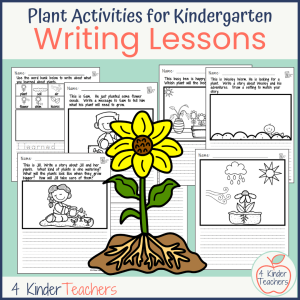
Writing Lessons – Plant Unit

Skills Lessons – Plant Unit

Math Lessons – Plant Unit

Science Lessons – Plant Unit

We had so much fun creating and teaching this unit and know you will enjoy it too! Please leave us feedback and any questions you may have -we love to hear from you! You get TpT credit every time you leave feedback to use on future purchases!
Reviews

There are no reviews yet.

Be the first to review “Plant Unit-Plant Activities for Every Subject”

Your email address will not be published. Required fields are marked *

Standards

With prompting and support, ask and answer questions about key details in a text.
 
With prompting and support, retell familiar stories, including key details.
 
With prompting and support, identify characters, settings, and major events in a story.
 
With prompting and support, ask and answer questions about key details in a text.
 
With prompting and support, identify the main topic and retell key details of a text.
 
Demonstrate understanding of the organization and basic features of print.
 
Follow words from left to right, top to bottom, and page by page.
 
Recognize that spoken words are represented in written language by specific sequences of letters.
 
Understand that words are separated by spaces in print.
 
Demonstrate understanding of spoken words, syllables, and sounds (phonemes).
 
Recognize and produce rhyming words.
 
Know and apply grade-level phonics and word analysis skills in decoding words.
 
Associate the long and short sounds with common spellings (graphemes) for the five major vowels.
 
Read common high-frequency words by sight (e.g., the, of, to, you, she, my, is, are, do, does).
 
Distinguish between similarly spelled words by identifying the sounds of the letters that differ.
 
Read emergent-reader texts with purpose and understanding.
 
Use a combination of drawing, dictating, and writing to compose informative/explanatory texts in which they name what they are writing about and supply some information about the topic.
 
Demonstrate command of the conventions of standard English grammar and usage when writing or speaking.
 
Print many upper- and lowercase letters.
 
Demonstrate command of the conventions of standard English capitalization, punctuation, and spelling when writing.
 
Capitalize the first word in a sentence and the pronoun I.
 
Recognize and name end punctuation.
 
Write a letter or letters for most consonant and short-vowel sounds (phonemes).
 
Spell simple words phonetically, drawing on knowledge of sound-letter relationships.
 
Determine central ideas or themes of a text and analyze their development; summarize the key supporting details and ideas.
 
Read and comprehend complex literary and informational texts independently and proficiently.
 
Write informative/explanatory texts to examine and convey complex ideas and information clearly and accurately through the effective selection, organization, and analysis of content.
 
Write narratives to develop real or imagined experiences or events using effective technique, well-chosen details, and well-structured event sequences.
 
Demonstrate command of the conventions of standard English grammar and usage when writing or speaking.
 
Demonstrate command of the conventions of standard English capitalization, punctuation, and spelling when writing.
 
Acquire and use accurately a range of general academic and domain-specific words and phrases sufficient for reading, writing, speaking, and listening at the college and career readiness level; demonstrate independence in gathering vocabulary knowledge when encountering an unknown term important to comprehension or expression.
 
NGSSK-ESS3-1
Use a model to represent the relationship between the needs of different plants or animals (including humans) and the places they live. Examples of relationships could include that deer eat buds and leaves, therefore, they usually live in forested areas; and, grasses need sunlight so they often grow in meadows. Plants, animals, and their surroundings make up a system.
 
NGSSK-LS1-1
Use observations to describe patterns of what plants and animals (including humans) need to survive. Examples of patterns could include that animals need to take in food but plants do not; the different kinds of food needed by different types of animals; the requirement of plants to have light; and, that all living things need water.
 
Write numbers from 0 to 20. Represent a number of objects with a written numeral 0-20 (with 0 representing a count of no objects).
 
Understand the relationship between numbers and quantities; connect counting to cardinality.
 
When counting objects, say the number names in the standard order, pairing each object with one and only one number name and each number name with one and only one object.
 
Represent addition and subtraction with objects, fingers, mental images, drawings, sounds (e.g., claps), acting out situations, verbal explanations, expressions, or equations.
 
Solve addition and subtraction word problems, and add and subtract within 10, e.g., by using objects or drawings to represent the problem.
 
Decompose numbers less than or equal to 10 into pairs in more than one way, e.g., by using objects or drawings, and record each decomposition by a drawing or equation (e.g., 5 = 2 + 3 and 5 = 4 + 1).